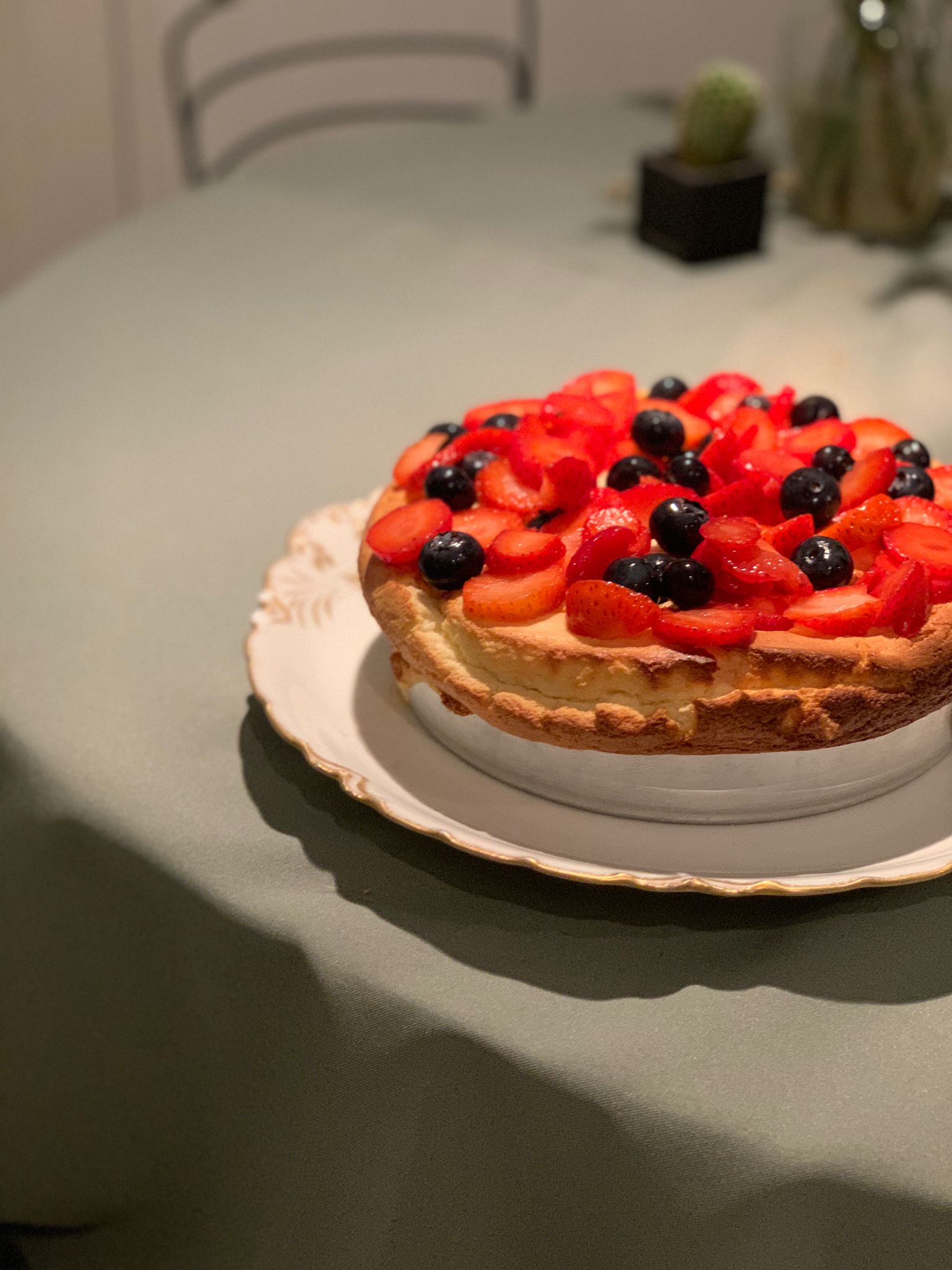
Cheesecake. Finally.

“It started with a cheesecake.” I’ve just spent a few minutes trying to force this line into Hot Chocolate’s “It started with a kiss.” It seemed promising, I could change the line “the back row of the classroom,” into “the middle shelf of the oven.” It all fell apart quickly. Which is exactly what I expected my first ever cheesecake to do.

This blog started with a cheesecake. So what better way to restart it? And as the days have ticked by since Shavuot, I’ve realised I have to seize the moment before the point when using #shavuot on Instagram would make little sense.

Speaking of not making sense- I told my brother that I’d stayed up all night for Shavuot. He said “Shove what?” In that way some of us have of repeating what we’ve said only louder, I kept trying until I was shouting one of the few words in Hebrew I know. Then he said, “You were staying up all night deciding what to shove? Like, should I shove a person? A fridge?” Which is when I heard his laugh bubbling. My kid brother is a master kidder.

Stars aligning, or just a common or garden human inclination to find patterns (which can solidify in conspiracy theorising)- however you want to analyse it, the last few weeks have seen an unprecedented level of coincidence in my life.

For instance-4th June 2022, the anniversary of what a friend called “my Jewish dunking day” happened to be Shavuot which is when the book of Ruth is read (the coincidence being that Ruth is commonly thought of as the first convert). A lot of people celebrate Shavuot with cheesecake. That weekend we were also belatedly celebrating Emily’s birthday and when I asked her what kind of cake she’d like….well you can guess what she asked for.

So it was that having stayed up all night on the 4th, I went to bed in that strange half-light when London was stirring and stretching limbs ready to get up. I had two hours sleep and woke up facing a morning of making meringues for a Jubilee party followed by…The Cheesecake.

The Cheesecake deserves at least a temporary capitalisation because in her book Claudia Roden includes it (along with bagels) as one of the symbols of the integration of Jews in American life, “and their part in shaping the ethos and character of the country and its largest city.” There is also a lovely story in her book linking cheesecake to a family who were kind to hers after they were forced out of Egypt.

I’d always thought of cheesecakes as simple. In my mind they were chilled bashed up biscuits with something like cream cheese on top. Yes there is cream cheese (I used it as a substitution for the 500g of curd cheese in Claudia’s recipe), which is mixed with caster sugar, sour cream/fromage frais, lemon juice and zest and some vanilla essence (I used vanilla bean paste which also seemed to work). But then things went off piste with the addition into this mixture of 5 egg whites which had been beaten into stiff snowy peaks.

The base was not crushed biscuits. My heart sank when I realised I had to make a dough, because my dough is usually ropey (it actually tastes like old rope). But this one (flour, salt, sugar, unsalted butter and 1 medium egg, lightly beaten), is in fact easy. A recipe which doesn’t need kneading. Right up my street.

All was going jolly well until the tiredness kicked in and I forgot how to blind bake. I merrily poured the ceramic baking beads straight onto the dough and popped it into the oven, returning half an hour later only to find I’d made if not The Whole of the Moon, a section of it. Craters. Claudia didn’t say I should make craters. Sarah inspected it and said “On Bake Off they do that sometimes it’s…decorative.” I’m sure she took one look at my appalled face (I resemble that anyway when I’m tired) and was just being nice.

When I came back from the Jubilee party it was time to pour the filling (which I’d left in the fridge) onto the cratered base. The cake then goes in for 1.5 hours and you finish by letting it cool slowly with the oven door open. Unfortunately I hadn’t left enough time for the cake to cool properly before the birthday celebrations so it came to the table warm. It also arrived decorated with strawberries and blueberries. Again, Claudia didn’t tell me to do this but it was a side-effect of using too small a cake tin so the whole thing souffled over the rim and cracked. From craters to ice flows I was going full geography.

But the thing is, it worked. And it was good.

Thank you Claudia. Thank you coincidence.
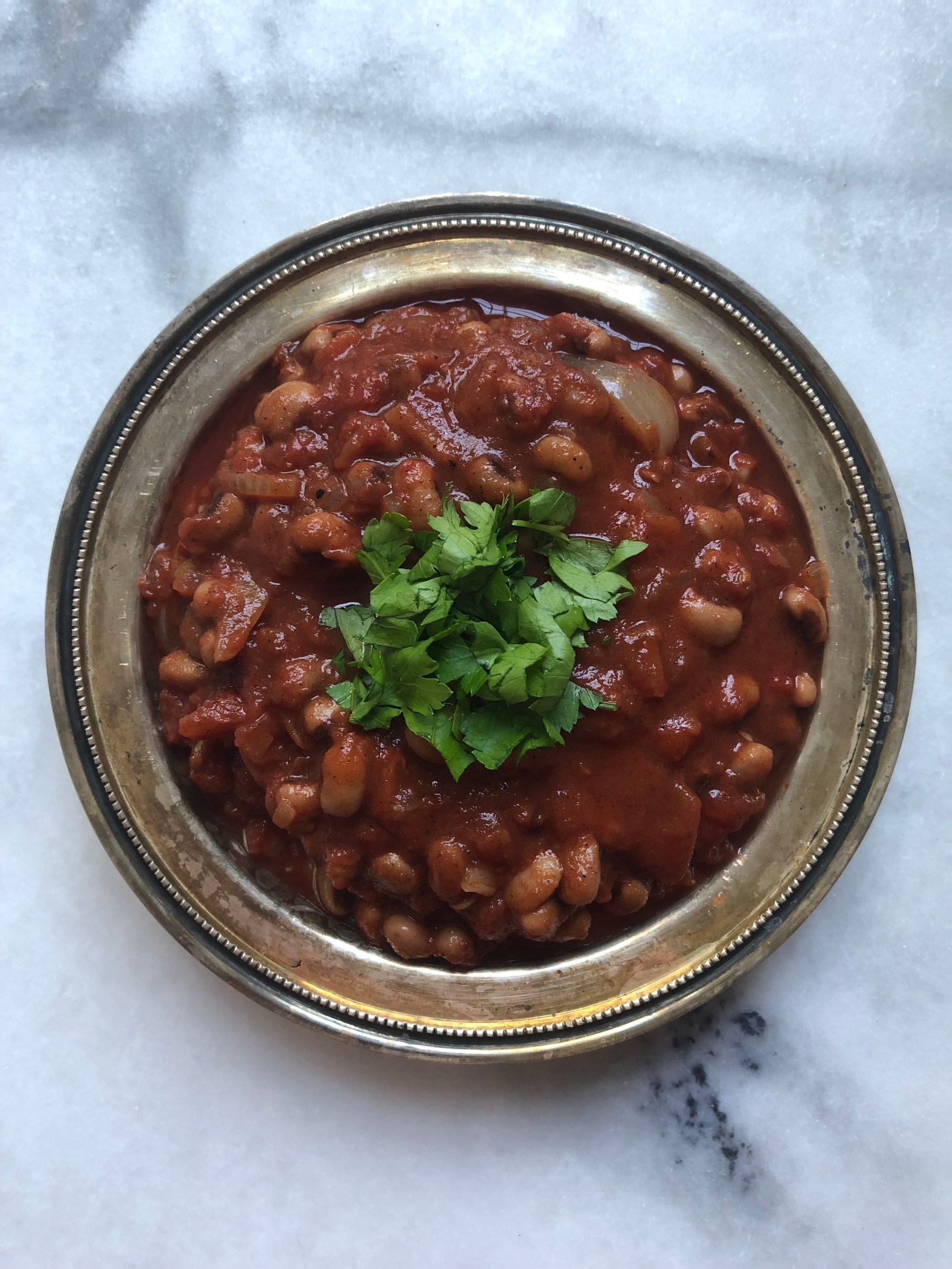
Here is the Love (black-eyed peas)

Making Claudia Roden’s black-eyed pea/bean (the legumes are called both) stew prompted me to think a lot about coincidences. So, in preparation for writing this post I decided to find out what “synchronicity” means (my father used the word twenty years ago, I didn’t ask him where it came from and then life moved on). I was a bit alarmed to learn it was coined by Carl Jung. Alarmed, because does anyone really want to delve into Jung early on a Sunday morning? Next thing I knew I was into Littlewood’s Law and the law of truly large numbers. Finally I read about quantum physicist Wolfgang Pauli who described synchronicities as “corrections to chance fluctuations by meaningful and purposeful coincidences of causally unconnected events.”

Then I called time. It was all too much entanglement before my morning caffeine.

When I’d had my nice cup of tea I dialled things down to thinking about story-telling and coincidences. It bothered me for a while that my novel relies on them. I spoke to my tutor on the Faber novel writing course and he said:

“You know the film Finding Nemo? Wait, hear me out. You’ve got this fish whose mum died and who has a really over-protective father. The fish has a distinctive fin. He gets lost and somehow winds up in the safest place a fish awaiting rescue could be…a fish tank.”

I think he must have then said something to tie it all up but (a) I can’t remember what it was and (b) I like it as it is, it has a guru-ring to it.

Let’s go back fifty paces to the peas.

I decided to do a big dinner for the second night of Rosh Hashanah. Under the “meat” entry for this high holy day in Claudia’s book I found Loubia (Black-eyed bean stew). I was pleased to find I could adapt the recipe (which is supposed to include cubed lamb or veal) to feed the four vegans coming to dinner. I was even more pleased to read that it was a Rosh Hashanah dish in Egypt. Claudia was born in Egypt (both her grandfathers came to Cairo from Aleppo in the nineteenth century) and lived the first fifteen years of her life there. The beautiful opening chapter to her book “A Celebration of Roots: Of Generations Past, Vanished Worlds and Identity,” weaves in descriptions of the Egyptian Jewish community, her family history and meditations on dishes as a symbol of continuity. This was my year of reading two extraordinary women from Egypt- Claudia Roden and Nawal El Saadawi. 2021 would not have been the same without them.

Again, back to those peas and coincidences. A few minutes into starting the dish, after I’d drained four cans of the peas/beans, had chopped and was frying two onions in a casserole on the hob until they were golden brown, what should my playlist randomly generate for me but “Where is the Love?” by Black Eyed Peas.

I listened to it on repeat a few more times through the rest of the stew preparation stages: adding four cans of tomatoes and 6 tablespoons of tomato paste, simmering the beans for 15 minutes, draining and adding them to the onion/tomato mix, adding 2 or 3 teaspoons of cinnamon and 1 or 2 teaspoons allspice, salt and pepper.

The casserole dish goes into the oven for 2 hours on a low heat (mine was about 150). You add bit of sugar after about an hour. I should say that because I missed out the 750g meat which goes in when the onions are browned, and because I was cooking for 12, I basically doubled or even tripled up the beans/tomatoes and the rest of the spicing (the measures above are my doubling/tripling). It’s one of those dishes it’s definitely important to keep tasting. When I made it again for Yom Kippur a week later this was a challenge, my friend Nik and I were both fasting and we had to waft the smells to work out if we’d got the spicing right, which reminded me of chemistry classes. Whatever I did, it seemed to work and of all the things I cooked over the high holy day period it was the standout favourite. You basically can’t go wrong with this.

But I’m not done on coincidences. While I was waiting for the stew to cook I got on with the rest of the preparations. Rosh Hashanah means ‘Head of the Year,’ so people often make whole roast fish complete with head. My vegans would probably run screaming if I’d put that down, even at the ‘meat’ end of the table, so as a head substitute I made whole roast cauliflower courtesy of Jamie Oliver. You make a paste to cover the cauliflowers before they go in the oven- olive oil, paprika and lots of fresh thyme. I was midway through chopping the mountains of fresh thyme for four cauliflower heads when my playlist randomly alighted on….Only Time by Enya.

I laughed out loud. I should add that I do have more than two songs on my playlist.

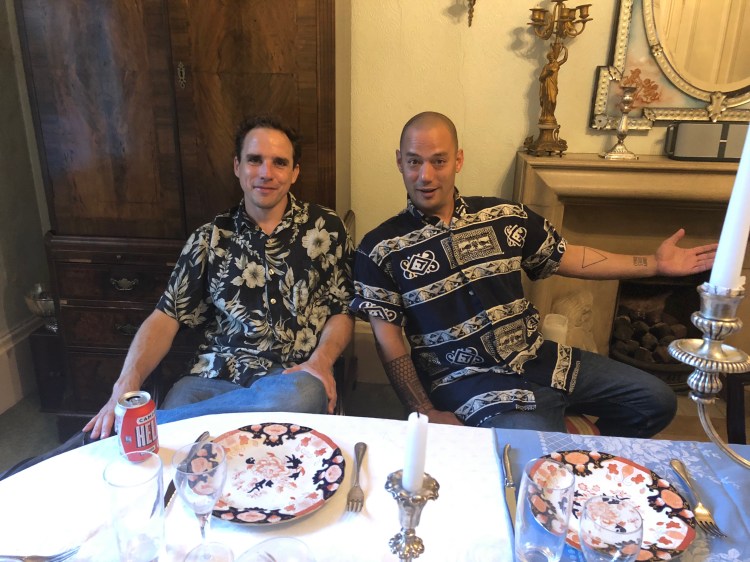
One final coincidence for the Rosh Hashanah dinner. Two of my favourite people were there that evening- Guy (my amazing brother) and Lee (my friend and owner of the excellent Bong Bongs Filipino restaurant at Seven Dials Market). They have met only once for a few minutes, they live on opposite sides of London, and I have never seen either of them wearing these shirts before. But here they are. I thought this was worthy of my first and possibly only inclusion of people photos on this blog.

Shanah Tovah!

Macaroons

No messing about with the title. No word play. Just Macaroons.

Which is not to say I haven’t spent the last twenty minutes trying to come up with something. Discarded were “Make Room for a MacaRoon” and “Make a Roon” (witchy). And I was going to kick off with a childhood reminiscence- there was a patisserie with amazing macaroons down the road from the dentist my mother took me to. When I went for the yearly check-up she’d let me have one BEFORE seeing the dentist. We started calling them plaqueroons. I decided against telling that story.

I have a real soft (and chewy) spot for macaroons. Maybe it’s dentine memories, or that they’re the perfect combination of crisp on the outside, soft on the inside (the biscuit equivalent of an armadillo). I suspect it might have something to do with the fact that you can eat the paper on the bottom, there’s a strange liberation from the norm in this. Or at least, I think you can eat the paper? Can you eat the paper?!

Claudia Roden’s macaroon recipe contains the best line in her entire book. It’s one that’s now being used quite regularly in my household to describe the general state of being human, when life can be difficult and simple all at once:

Claudia says: “Although they are very easy to make, they are very tricky.”

Just brilliant.

She’s right, they are very easy. Although my heart sank when I read that I needed to make something “walnut-sized” again. I couldn’t believe that after the Menena experience (see my post Me-ne Me-nena) I still hadn’t got my nuts in a row and purchased a walnut for accurate sizing.

Mix 200g of ground almonds with 150g sugar and a few drops of almond essence, add the white of one egg and work the mixture into a stiff paste. Remove your family heirloom sizing walnut from its hyperbaric chamber. Size the mixture correctly then shape into round flat cakes. Put on a baking sheet with greaseproof paper and bake for 8-10 minutes.

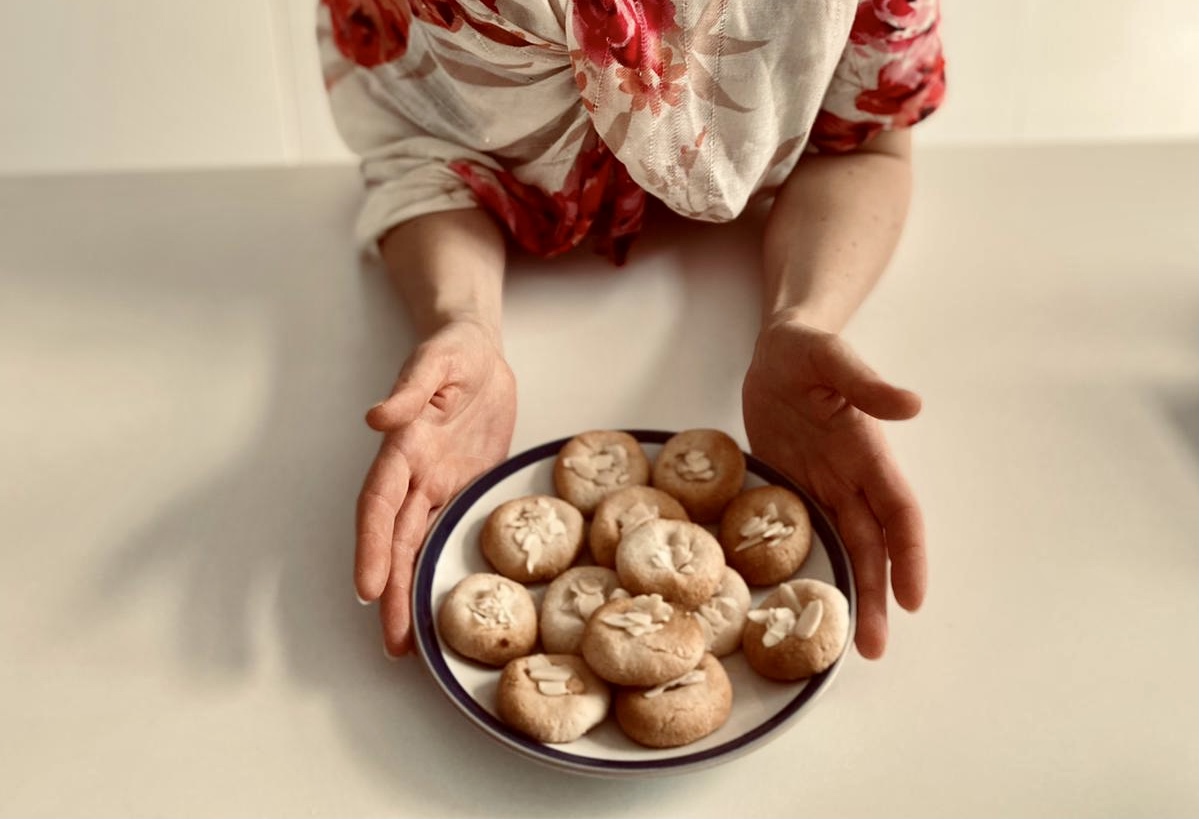
I’ve always found the blanched almond on top of the macaroon a particularly appealing feature. I didn’t have any so stuck a whole almond in while the macaroons were still cooling (I was in a rush). The results were predictable. I dented my macaroons. And my baking pride, because I’d excitedly announced to Tamara (she of the glorious mother with the cheesecakes see my post Beginnings) that I’d bring something for tea. I put some crushed almonds into the dents and cycled to East London. When I arrived, the nuts had, unsurprisingly, flown their nests. Tamara and Dan were patient while I made them turn their backs as I reassembled them. Tamara then took the photograph above which shows the almonds just about staying put.

T and D were kind about them, and I’ll revel in even the smallest praise from soon-to-be chocolatiers!

The rest of Claudia’s macaroon entry has a wonderful tip on a Jewish pastry shop in Rome. I’ll leave that for you (whoever you are!) to discover on reading, and see you there.

And don’t worry, I didn’t eat the greaseproof paper……much.

Green Fennel Fairy

I have never drunk absinthe. A friend of mine had it late one night at university and fell into a box hedge which, unlike him, never recovered.

When I started this post I looked up “fennel,” and found out:

(a) it’s an ingredient in absinthe

(b) that the Greek for fennel is “marathon,” the place Marathon (of the famous battle) was so-called because it was a “plain of fennel”

(c) absinthe is not illegal (I’d always thought it was). I also found a brilliant undated archived page in the Guardian called “Nooks and Crannies,” in which the discussion of the legality of absinthe included this exchange:

“It is a well known historical fact that the reason Van Gough (sic) cut off his ear was because, after a session on absynth (sic) with Monet he wanted to make a point over the colour red, cut his ear off and lobbed it at his friend Claude Monet.” From Mark in Scotland.

“Marc, it was Paul Gaugin, not Monet..” From Cathal in Ireland.

If only more internet chats were this civilised.

The first time fennel appeared in my veg box I stifled a small panic. Of course fennel isn’t inherently scary. Although if you found it semi-submerged in a muddy field you might think the worst- in January a large scale police search was triggered by someone thinking a potato was a toe poking out of the soil. The fear in this case was occasioned by holding the bulb in my hand for ten minutes and being unable to remember what it was called. I even googled “green vegetables” and scrolled through endless images. I gave up and texted my mother:

“What are the vegetables that look like hands?”

“Hands????”

I sent her a photograph.

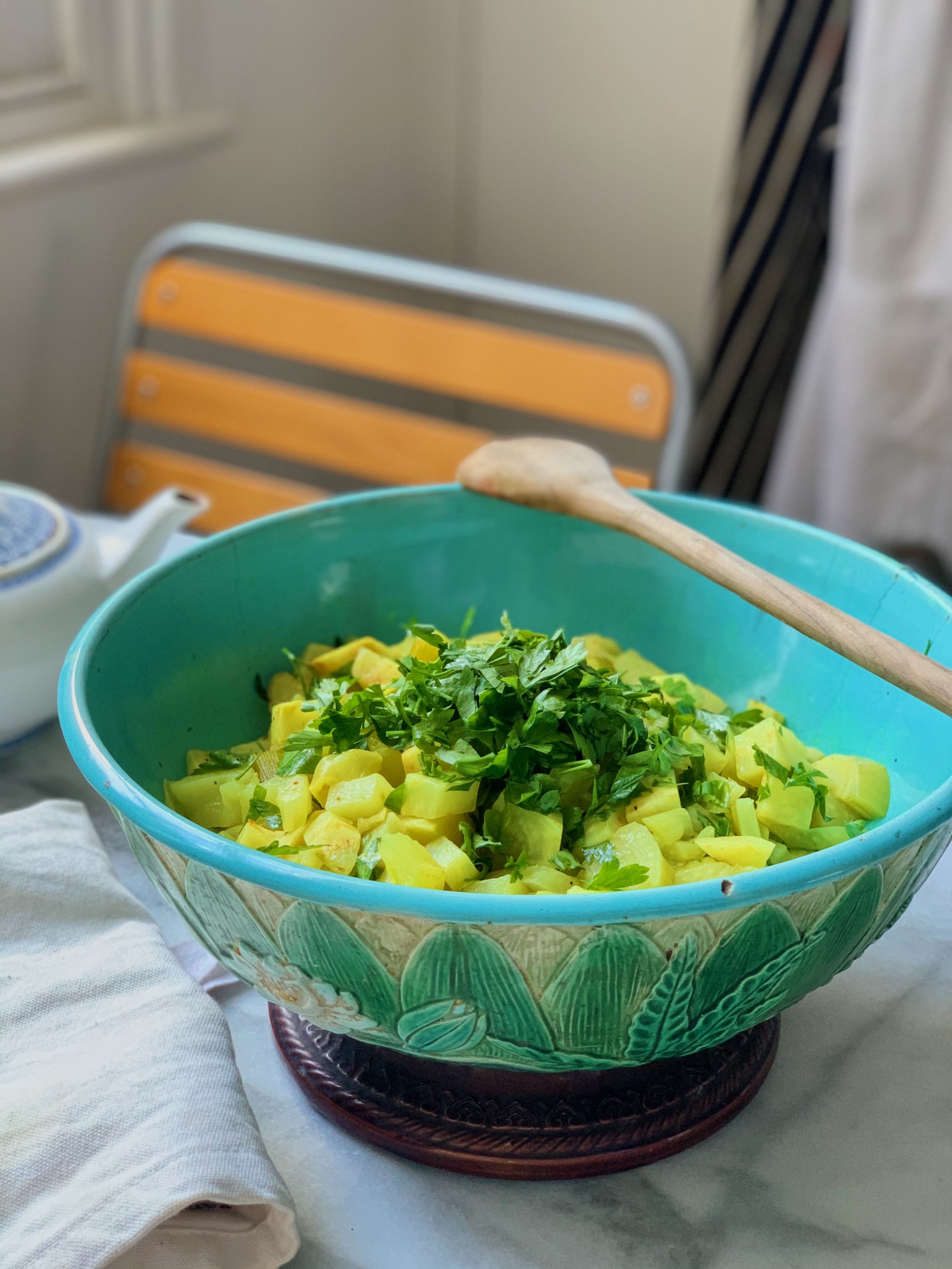
Celebrations marking the return of the word fennel to my vocabulary continue with Claudia’s citrusy celeriac and fennel salad.

You put small chunks of a whole peeled celeriac, and thick slices of one large fennel head into a large pan. In fact the first step is to fry off several garlic cloves in the pan, but you know me and aliums (see my post Muhammara).

Back to the salad: Add the juice of two lemons, salt, pepper and a bit of sugar, with a few pinches of turmeric and water. You simmer the whole lot with the lid on for thirty minutes then take the lid off and reduce the liquid to a thick sauce.

I definitely added too much water as I didn’t get to the thick sauce stage despite quite a lot of simmering sans lid. Claudia says you should ‘barely cover’ the vegetables with water. That’s what I did, but my sense is this might be quite pan-dependant (sounds like co-dependant but for the whole world). In fact when we ate it as a household I did ask some of the more scientifically minded to explain to me whether the circumference of the pan would impact on how much water you would have if you were “covering,” the vegetables. Someone talked me through the maths, but I can’t remember what they said. Now, what was the name of the vegetable that looks like a hand?!

I would err on the side of less water, i.e. not covering, and then see how you get on. Every time you stir you can just test for how cooked the vegetables are. You can always add more water.

Serve cold with lots of chopped flat leaf parsley on top. Absinthe optional.

Many Hands Make Light Hallah

I know a yeast story.

How often do people start conversations that way? I would have said never, but it’s been a year of lockdowness and home-baking, so there’s a chance that somewhere, somehow, someone has said that sentence before me (it was probably ten a penny in the 1940s).

Speaking of the 1940s, here is the story.

In 1942, Adnams Brewery in Southwold, Suffolk, was in dire straits- the yeast was infected. As any keen sourdoughers know, this inevitably put a halt on all things hoppy. Adnams trotted down the road, beaker in hand, to Morgans Brewery of Norwich and bought a batch. Not long after, the whole Morgans brewery was destroyed in an air raid. The 1942 yeast is still in use by Adnams. The idea that there is an 80 year old yeast alive and well today is strangely moving (and unsurprising to anyone who arranges for people to feed their yeast when they go on holiday). The story is also a reminder of all the windows into history we walk past and forget to look in. If I hadn’t heard the yeast tale I’d never have learnt about the WW2 Baedeker air raids on historic cities- York, Canterbury and Norwich, where buildings of cultural importance were targeted. The name came from Baedeker, a series of German tourist guidebooks which included detailed maps that were used to generate the targets. And I would never have known the story of John David Grix, a 15 year old cycle messenger who during the Norwich raids put out an incendiary bomb and saved a house by closing off a gas leak. He became the youngest person to receive a gallantry award.

Thank you yeast.

And thank you to my friend popular science author Lewis, who took time out from writing his follow-up to the best-selling Origins, to help me with the bread. I was going to say it was apt that someone who describes the impact of geology on human evolution should be with me for my first attempt at the bedrock of Ashkenazi food, but the truth is I needed him (how did I resist saying ‘kneaded’ there?). He is the yeast whisperer.

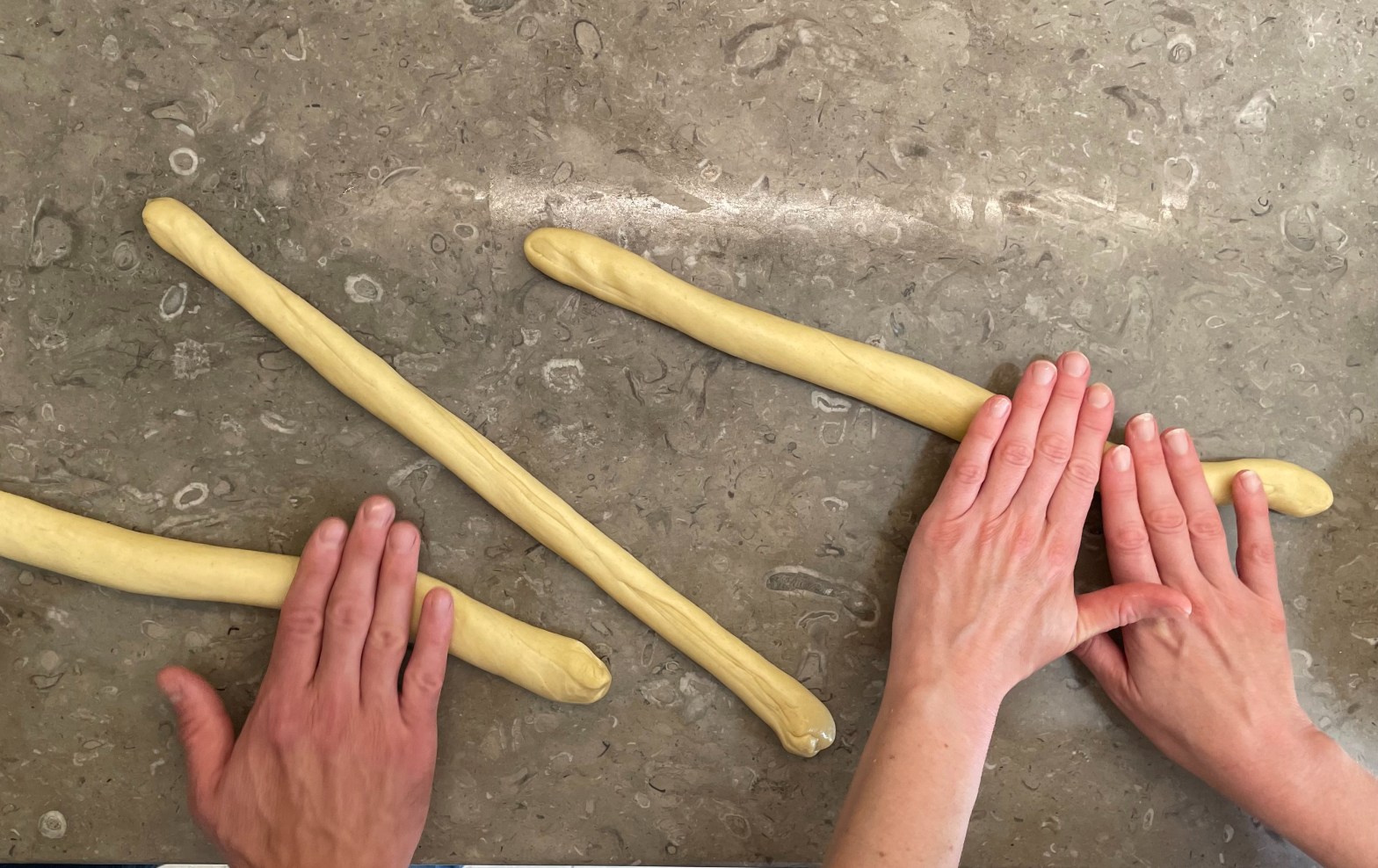
Prepare your yeast (2 tablespoons dry yeast, 1 teaspoon sugar and 500ml lukewarm water). Beat 4 eggs, add 1 tablespoon salt, 100g sugar, 125ml oil and beat again, add the now frothy yeast mixture. Add 1.3k plain flour slowly, to make a soft dough. Knead it until it is elastic and put it in a greased bowl. Set aside for 2-3 hours or until doubled in bulk. When it has doubled, punch the dough down and knead it again, then divide into four pieces. Each piece you divide to create three rolls (see the picture) which you then braid together. Once you’ve finished your plaiting, pop the loaves on a baking tray and leave them to rise for an hour. Brush with beaten egg yolks then put them in the oven for 30-4o minutes or until golden brown.

The three strands of the hallah represent truth, peace and justice. In the interests of ensuring the first, I have to disclose that the hallah didn’t work. The eagle-eyed amongst you might have noticed from the picture that our dough strands were too long, perhaps this was the problem, perhaps it was because we didn’t allow the stipulated rising time. Perhaps, perhaps, perhaps.

I’ve decided the best way to approach my hallah-failure is to look at the symmetry, not so much with the loaf, which was deeply unsymmetrical, but with the time of baking. We made the bread two days after I’d been to the mikveh (ritual immersion) to complete the conversion process. Just as I was starting out on a journey into my Jewish life, I took the first step towards hallah-greatness. The fact that that step was a firm and solid one, seems only appropriate.

A courgette not to forget

Uncourgettable

I’ve overstretched. When is a courgette ever unforgettable? And now I’ve gone way existential (see Clueless for reference) I have form on this. At a moment of high tension in one of my friend’s novels a character stuffs incriminating papers into a “disposable bag.” When he’d digested my feedback on the draft my friend emailed, “I am willing to forgive the half an hour philosophical traipse you sent me on with ‘What makes a bag disposable?’”

To make things worse, I’ve realised that the life snippet I wanted to weave into this post doesn’t work. The tale I intended to tell has to do with cucumbers. A courgette by any other name is not a cucumber.

Never one to let words get in the way of a good story…recently I was asked to read from the Haftarah (extracts from the Book of the Prophets). It was my first time standing on the bimah (the platform in the synagogue from which people read or give sermons). I decided that as reading from long sometimes difficult to follow passages is part of my job I wouldn’t give the text more than a cursory glance in advance.

The synagogue’s Haftarah book is an ancient tome, one of those you might pull out of the bookcase to activate a secret passageway, or thud down on a desk, and open in a cloud of dust to find a spell. I managed the first page sounding suitably stentorian. Then I switched my gaze to the page on my left, because it’s a synagogue so you read right to left, right? It took me a few sentences to realise what I was reading made no sense. The rabbi joined me on the bimah, and asked me where I thought I was. Not in a “who do you think you are?” way I hasten to add. Others crowded around, at a loss as to where it had all gone wrong. Then a hand, I don’t know whose, turned the page making it clear that I needed to be reading left to right, right? As he stepped off the bimah the rabbi said “don’t worry you’re doing really well.” We all knew I wasn’t.

Surprisingly, I was invited back the following week. I assured everyone that as I now knew which way the book went, I wouldn’t mess up. The book had other ideas. When I squared up to it the designated page fell out. I ploughed on.

I decided to erase all public memory of my prior performance by giving a perfect rendition in Hebrew of the prayer said after the reading. I was a sentence in when I lost all sense of the letters, and any clue as to how to say the words. For a moment I wondered if I should just run a bunch of consonants together, “vdchbv,” and hope no-one noticed. Plan B was to stand really still and hope no-one noticed, that I even existed. Someone in the wings murmured the word and I continued, sort of, kind of, just about, probably 32% accuracy. After the first paragraph there was a collective exhalation, and a few “shkoyachs” (good job) before everyone realised I had two paragraphs to go. Collective inhalation, and holding of breath.

What might you ask has any of this to do with cucumbers? It’s because the only thing I can remember of either of these embarrassing attempts at reading is the line, “a lodge in a garden of cucumbers.” I expect the writers really meant courgettes but got confused, it’s easily done.

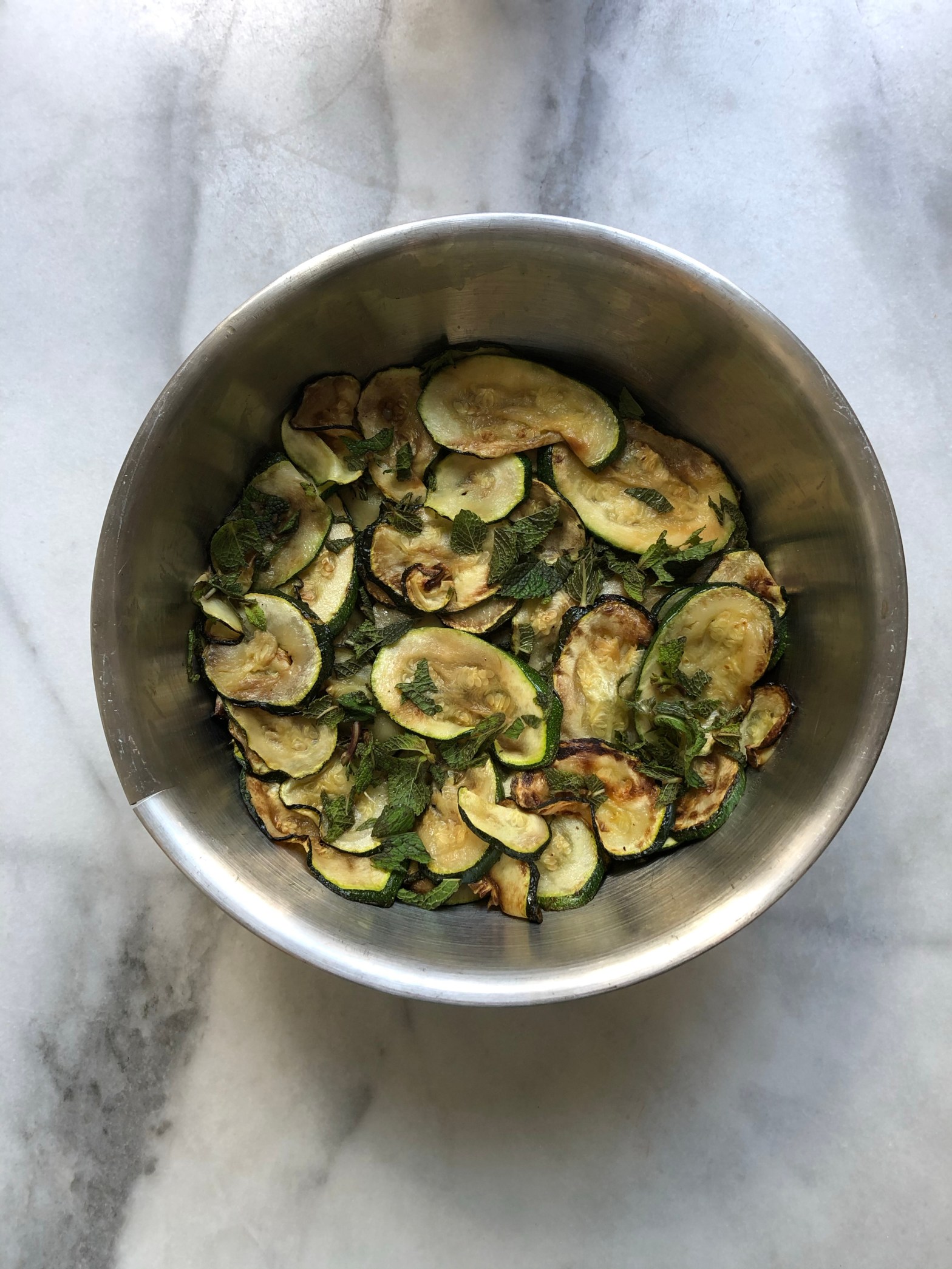
Drum roll for the courgettes/non-cucumbers, in this case marinated. They’re a Sicilian specialty brought to the North of Italy by Jews fleeing the Inquisition. You fry slices of courgette until they are turning brown on both sides, dry them on kitchen paper, then layer the slices in a bowl, sprinkling the layers with mint leaves, dashes of vinegar, sugar and salt. You could also add finely chopped garlic into each layer (see previous posts for why I don’t). Leave to marinate for a few hours and serve cold.

Now I think about it, it would probably work with cucumbers too. But I’m faithful to Claudia.

If in doubt, bake.

I started writing a few years ago. Whenever people say they’ve started writing they usually tack on “seriously,” but in my case it wasn’t serious. It was, however, prolix. To be precise, 83,252 words over the course of three months. Wordy- like this opener.

The reason all those words tumbled out was because, like many people, I was writing as a distraction. I made up a morning mantra, “if in doubt, write.” There was a lot of doubt, so there was a lot of writing. I wrote, and wrote, and wrote, then stopped, tortured my step-sister by making her read the whole thing (including two embarrassingly badly written, and just generally embarrassing, sex scenes), and put it in a drawer.

Today I had the sort of day my father would describe as “marginal,” aka, unideal. The sort of day you can have in the life of a barrister which makes you wonder how mighty the pen really is. A sense of injustice is not a comfortable thing to sit with, it sprawls, gets its elbows out, takes up all the space on the bench and eats the last of the roast potatoes.

And then I remembered the mantra, “if in doubt, write,” and developed it into, “if in doubt, bake,” or to combine the two in a sweet synthesis, “if in doubt, write about baking.”

This has prompted me to return to my long-neglected blog. I’d like to say it was set aside because I’ve been busy with novel no. 2, but I was stuck there too. The mantra had failed me. Perhaps the problem wasn’t doubt, but certainty. I was sure I couldn’t move the story on. So I’d abandoned one of my characters sitting at dawn on a wall in New York after cheating on her girlfriend (not on the dawn wall at least), another driving back from Heathrow, and the third of my trio of women standing half-way up the stairs of the Wiener Library.

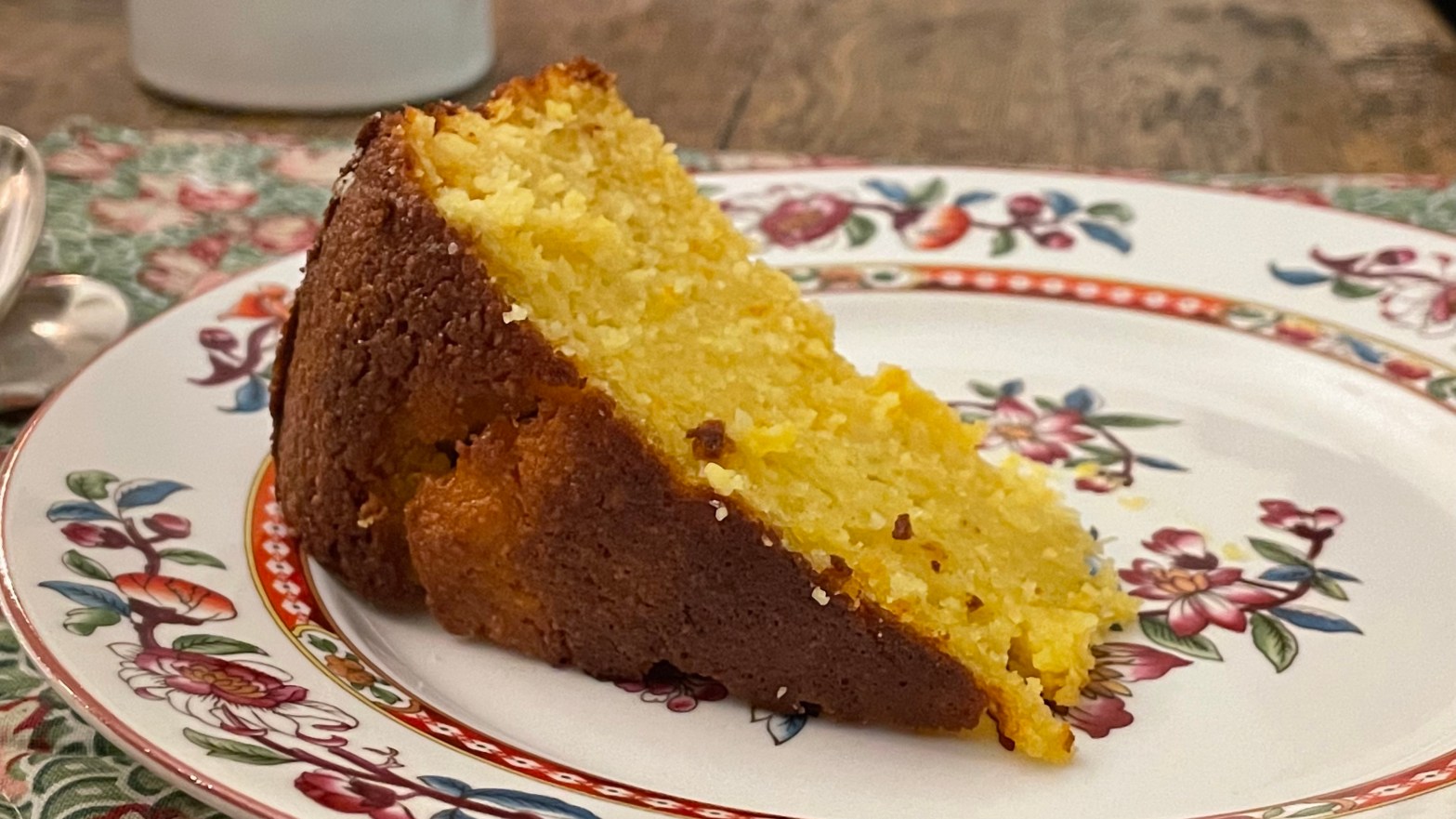
To celebrate my return to the blog I’m writing about my happy experiences baking Claudia Roden’s famous Orange Cake. For anyone who has Claudia’s book, you’ll know that she is not given to self-congratulation but even if she were this cake entirely deserves the line she includes, “it has been widely adopted (it is on the menu of several restaurants in Australia).”

It is the cake that launched a thousand pounds on my hips.

The very process of making it will bring joy. Firstly because you wash and boil 2 whole oranges (including their skins) for 1.5 hours or until they’re soft. I know, I know, you can put them in a bowl in the microwave with cling film on but that would take away the sensation of being in an orange grove on a particularly steamy day. You can just re-locate your working from home to the kitchen to keep a bit of an eye on them. I promised more Northernerisms- doing a bit of something rather than the whole shebang is a classic. I grew up in a house in which when it got cold you were told to “put a bit of a coat on.” Always begging the question from us little cheeksters, “what, like, a sleeve?”

The reason you keep the skins on (Rob was suspicious at first) is because it gives the whole thing a wonderful zesty kick. When they’re soft (knife point test) you cut them open, remove the pips, and purée the oranges in the food processor. The cakey bit of the cake is made with almond flour, sugar, baking powder and eggs, along with 2 tablespoons of orange blossom water. Mix the whole thing together and put it in a 23cm cake tin in an oven at 190 C for an hour. Here is the recipe.

Now, this is a cake that starts out extremely easy but in the home stretch requires a bit of care. By which I mean that my friend Rob, Director of Photography par excellence and general cake rescuer (here he is with David Attenborough), had to go and check on it six times because it did seem to stay quite wet and yet at the same time go dark on the top quickly. I’d advise some tin foil on the top in the latter stages, and patience. It is after all, a virtue.

When life gives you lemons, make lemonade, when life gives you limes make love, and when it gives you oranges, make this cake, share it, and all will be well.

Hello Yellow Risotto

I spent my Saturday night cleaning. At 10pm it was just me, a mop and a bucket. When I took a break and leaned on the mop, resisting the temptation to wheel around with it like a smooth gliding dance partner, I realised I’d gone full Cinderella, dreaming of a fairy godmother who’d magic me away to the ball, and wearing an old snood as a headscarf. When he first saw it a while ago (these have been hairdresser-less months) Hesham said “nice tichel.” I nodded and slyly googled “tichel.” Before I quickly move on to slow cooked rice, I’d like to reflect the loveliness of a Muslim friend teaching me Yiddish.

In the spirit of my La Cenerentola moment I’m leaning in, not just to my mop, but to the delights of Italian Jewish cooking.

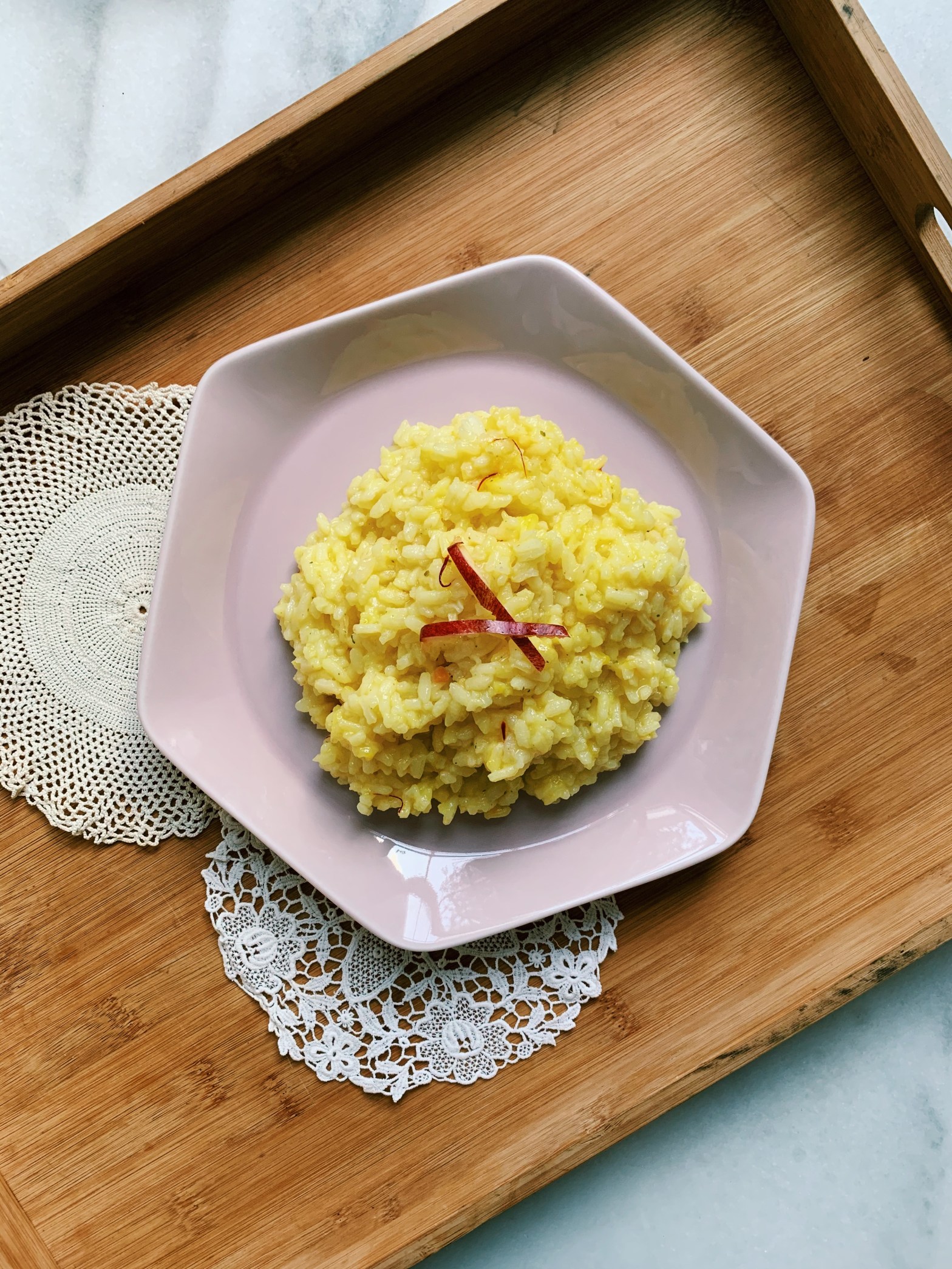
Risotto Giallo (full name Risotto Giallo del Shabbat) is, Claudia Roden explains, said to be the origin of the famous Risotto alla Milanese. It’s an old Jewish speciality of Ferrara and Venice and served on the Sabbath as a first course or a side dish. I’m going to come on later to how delicious it is, but I’ll preface this by saying that it was so delicious I ate it as a first course, then as a side dish, then just gave up self-denial and ate it as a main course, all in the course of one evening.

I am not going to dwell on how simple it is, because Emma says that in this blog I sell my culinary skills short. Instead I’ll say that cooking the rice (about 300g) in oil until it is “translucent,” is much harder than it sounds (hint: it isn’t). Adding a litre of stock, pouring it onto the rice, stirring it once, and putting the lid on the pot, is the very definition of taxing. You leave the lid on for about 20 mins until the rice has soaked up all the liquid but hasn’t gone into the irretrievably mushy stage. Your anxiety levels will be peaking at this point (correction: they won’t, not unless you’re watching Eurovision at the same time). Five minutes before the end you stir in a few strands of the saffron so it steams with the rice and turns it a wonderful, well, yellow. Roberto’s your uncle!

Even for those who, like me, know little about the 500 years of Jewish history in Venice, there are two associations that likely come to mind- Shakespeare’s play and the word “ghetto.” The origin of the second (and come to think of it the first) are disputed. The most commonly accepted etymology is that it comes from the Venetian word “ghèto” meaning “foundry” as there was one near the site of the Jewish area of the city. Other theories are that it comes from the Hebrew “get” meaning bill of divorce or the Yiddish “gehektes”, meaning “enclosed.” Whatever it’s derivation, it remains a word which, as Daniel B Schwartz (who has written a book on the history of it) says, “carries a special ideological charge and is capable of evoking images and associations that exceed any dictionary definition of the term.”

The still-named Ghetto Nuovo in Venice has a particular resonance for me. It’s where I went into a synagogue for the first time-the Scuola Grande Tedesca, built in 1528 by the Ashkenazi community and the oldest of the five synagogues in Venice (all of them termed “scuola” rather than “sinagoga,” just as the Ashkenazim would use the Yiddish “shul.”).

Back then, I could never have imagined I’d be writing this blog, making Claudia’s fiendishly difficult yellow rice and attending my own shul, but “non tutte la ciambelle riescono col buco.” In this case, it’s a very good thing.

Me-ne Me-nena

Forget Mahna Mahna by the Muppets, I bring you Me-ne Me-nena by a Muppet.

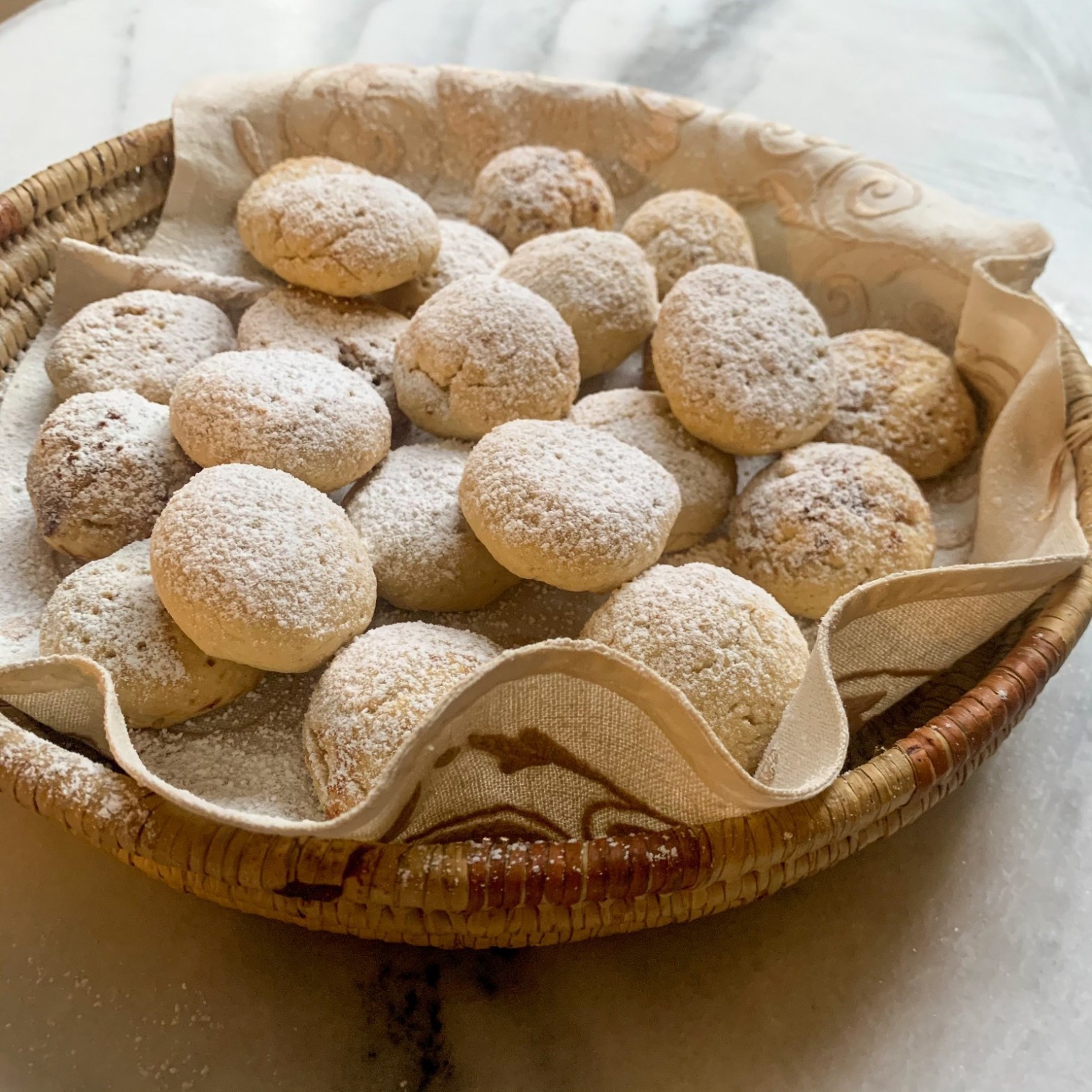
Menena, in Arabic Ma’amoul, are datey or walnuty cookies come crumbly shortcrust pastry pies. You can also make them with a crushed pistachio filling- the luxury option.

As I write Youtube has segued from Mahna Mahna to the Muppets’ Bohemian Rhapsody. I’m not going to share the link, Sunday is not a good day to take down musical icons.

Back to the Menena: the pastry dough is made with an entire packet of butter, flour, and not much sugar at all. This makes sense because the crushed walnut filling has sugar in it and the whizzed up date filling is naturally sweet. The key ingredient in the dough is the rose water, a tablespoon of it, which sounds a lot, and is. When you eat it, it works, but the initial smell is quite….bath salty. Emily walked into the kitchen when I’d taken them out of the oven and wondered if someone had spilt a cleaning product everywhere. I hasten to add we don’t usually have rose scented cleaning products lying around, we are not a hammam, though the kitchen can get a bit steamy. But you know what they say, if you can’t stand the heat, open a window.

The fillings are easy, crushed walnuts (the food processor did the crushing for me) mixed with sugar and cinnamon, and then a date paste alternative, which is just pitted dates blended in the processor with some water.

Less easy was the assembly. You start with a walnut sized piece of dough. Next time I make them I’m going to buy a walnut for comparison because as ever, I really struggled with the size. You press your thumb into it and then work it as if you were making a clay pot. Move over Demi Moore. You fill each pot three quarters and then seal them up and roll them into a ball. I couldn’t get the date filling to stop oozing out. This meant that when it came to decorating the cookies before they went in the oven- you can prick them with a fork or use special pincers- I had to abandon that step. It felt like puncturing the balls and giving the date more of an excuse to escape wasn’t a great plan.

As for the special pincers, Claudia Roden explains that for years her mother looked for the exact ones with which to make a little design on top and in the end found somebody to make one for her. I am going to search, sadly I don’t know anyone who could make one for me…..yet…..because you never know what pincer movers and casters are going to come into your life.

Claudia says the cookies should then go on a lowish heat 160 degrees for 20-30 minutes. The trick apparently is to cook them until they don’t go brown. This reminds me a bit of my mother’s route when she used to drive me to university. She’d been reliably informed by someone that the best way was to aim for the Blackwall Tunnel and then at the last moment miss it. I grew to love the Blackwall Tunnel.

The good news is that if you do the menena equivalent of going through the tunnel and slightly browning the pastry, you can dust the whole lot with icing sugar.

I’m going to finish on a serious note, which might sit ill with the jocular start. Menena/Ma’amoul have links to four religious festivals: Some Jews make them for Purim, Greek Orthodox Christians make them for Easter, Muslims make them during Eid al-Fitr, and Muslims and Druze enjoy them for Eid al-Adha.

The serious note is this BBC article I read just last night (two days after making the menena) ‘Lebanon Easter biscuit woes symbolise crumbling economy.’ I’m not sure that ‘biscuit woes’ in the headline does justice to the difficulties the Lebanese are facing. The final sentence of the article however does, “Many families this year aren’t able to make any.” I count myself extremely lucky that I am.

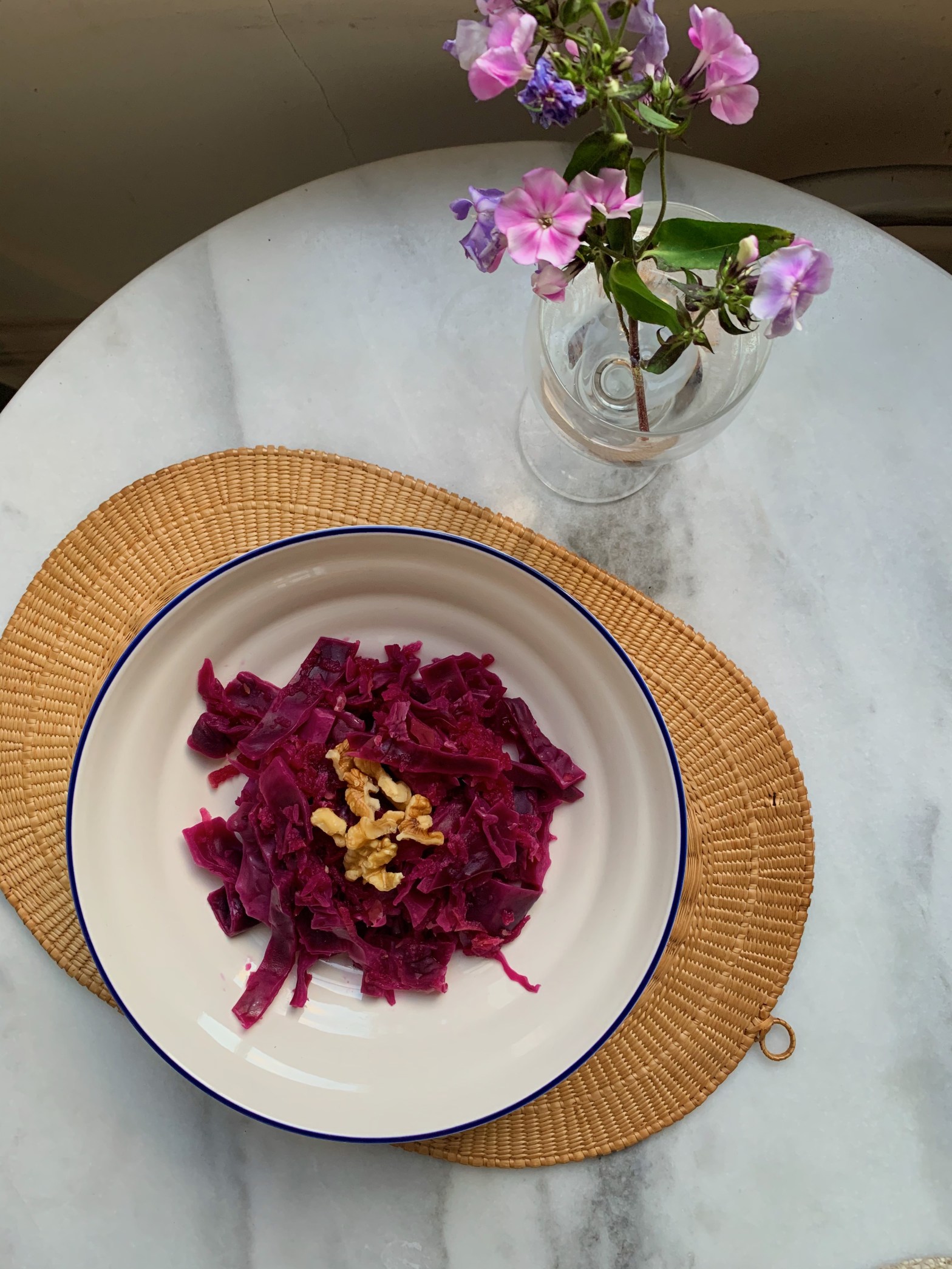
A Red, Red Cabbage

Oh my Luve is like a red, red cabbage

That’s newly sprung in November;

Oh my Luve is like the melody

I can never quite remember.

So fair art thou, my bonnie lad

So deep in luve am I;

And I will luve thee still, my dear

Till a’ the pans gang dry.

By Amelia, after Robert Burns’ original, and probably quite a lot better poem A Red, Red Rose.

Another literary diversion before I get to the delights of making Sweet and Sour Red Cabbage with Apple (because much as I can make recipes complicated this one really isn’t)- I’m fairly sure someone told me once that in his novel Hangover Square Patrick Hamilton writes about the distinctive smell of boiled cabbage in an Earl’s Court flat.

Having dug through the internet a good long while trying to find the reference and coming up cabbage-less, I reluctantly took Hangover Square off the bookshelf. I read it this time last year, probably not the best time for a book described on the back as ‘capturing the premonitions of doom that pervaded London life.’ I couldn’t bring myself to delve again into the ‘drunken hell’ of George Harvey Bone just for a quote. I would make a dreadful journalist.

However, the Financial Times rescued me with an article on Brussels Sprouts, one of the cabbage’s brassicacea cousins. It says: “overcooking releases sulforaphane, the “boiling cabbage smell” that Hangover Square author Patrick Hamilton managed to parlay into a literary genre, but you probably don’t know that sprout stems make amazing walking sticks, as strong and whippy as malacca cane, and that certain varieties are grown for the particular purpose of their manufacture.”

I can just imagine the Faber & Faber meeting now, “We’ve got a lot of Bildungsroman and Techno-thrillers coming through, Melanie anything from your side in Boiled Cabbage?”

After all this preamble, red cabbage doesn’t in fact smell when you cook it, certainly not when you’ve added two large grated apples, splashes of cider vinegar, lemon and sugar. I could make it sound a lot more tricky than combining those things (along with 125ml water, 2 tablespoons of oil) and one shredded large red cabbage, and steaming the mixture for 20 minutes or until very soft. But I won’t.

It’s a perfect accompaniment to roast meat, but having not yet embarked on the meat sections of Claudia’s book (due to mostly cooking for the household of aforementioned vegans), I can reliably say it’s delicious on its own.