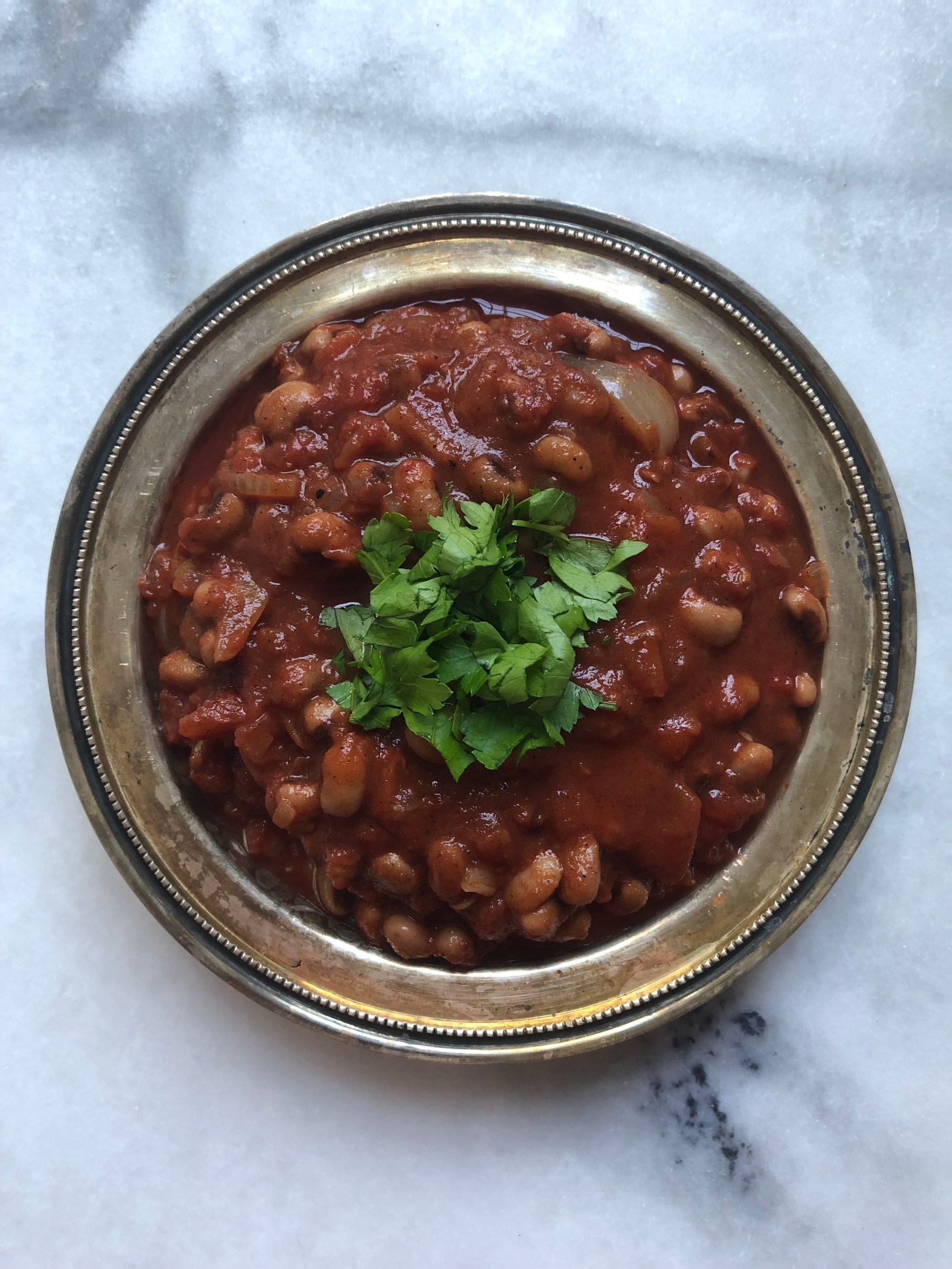
Making Claudia Roden’s black-eyed pea/bean (the legumes are called both) stew prompted me to think a lot about coincidences. So, in preparation for writing this post I decided to find out what “synchronicity” means (my father used the word twenty years ago, I didn’t ask him where it came from and then life moved on). I was a bit alarmed to learn it was coined by Carl Jung. Alarmed, because does anyone really want to delve into Jung early on a Sunday morning? Next thing I knew I was into Littlewood’s Law and the law of truly large numbers. Finally I read about quantum physicist Wolfgang Pauli who described synchronicities as “corrections to chance fluctuations by meaningful and purposeful coincidences of causally unconnected events.”
Then I called time. It was all too much entanglement before my morning caffeine.
When I’d had my nice cup of tea I dialled things down to thinking about story-telling and coincidences. It bothered me for a while that my novel relies on them. I spoke to my tutor on the Faber novel writing course and he said:
“You know the film Finding Nemo? Wait, hear me out. You’ve got this fish whose mum died and who has a really over-protective father. The fish has a distinctive fin. He gets lost and somehow winds up in the safest place a fish awaiting rescue could be…a fish tank.”
I think he must have then said something to tie it all up but (a) I can’t remember what it was and (b) I like it as it is, it has a guru-ring to it.
Let’s go back fifty paces to the peas.
I decided to do a big dinner for the second night of Rosh Hashanah. Under the “meat” entry for this high holy day in Claudia’s book I found Loubia (Black-eyed bean stew). I was pleased to find I could adapt the recipe (which is supposed to include cubed lamb or veal) to feed the four vegans coming to dinner. I was even more pleased to read that it was a Rosh Hashanah dish in Egypt. Claudia was born in Egypt (both her grandfathers came to Cairo from Aleppo in the nineteenth century) and lived the first fifteen years of her life there. The beautiful opening chapter to her book “A Celebration of Roots: Of Generations Past, Vanished Worlds and Identity,” weaves in descriptions of the Egyptian Jewish community, her family history and meditations on dishes as a symbol of continuity. This was my year of reading two extraordinary women from Egypt- Claudia Roden and Nawal El Saadawi. 2021 would not have been the same without them.
Again, back to those peas and coincidences. A few minutes into starting the dish, after I’d drained four cans of the peas/beans, had chopped and was frying two onions in a casserole on the hob until they were golden brown, what should my playlist randomly generate for me but “Where is the Love?” by Black Eyed Peas.
I listened to it on repeat a few more times through the rest of the stew preparation stages: adding four cans of tomatoes and 6 tablespoons of tomato paste, simmering the beans for 15 minutes, draining and adding them to the onion/tomato mix, adding 2 or 3 teaspoons of cinnamon and 1 or 2 teaspoons allspice, salt and pepper.
The casserole dish goes into the oven for 2 hours on a low heat (mine was about 150). You add bit of sugar after about an hour. I should say that because I missed out the 750g meat which goes in when the onions are browned, and because I was cooking for 12, I basically doubled or even tripled up the beans/tomatoes and the rest of the spicing (the measures above are my doubling/tripling). It’s one of those dishes it’s definitely important to keep tasting. When I made it again for Yom Kippur a week later this was a challenge, my friend Nik and I were both fasting and we had to waft the smells to work out if we’d got the spicing right, which reminded me of chemistry classes. Whatever I did, it seemed to work and of all the things I cooked over the high holy day period it was the standout favourite. You basically can’t go wrong with this.
But I’m not done on coincidences. While I was waiting for the stew to cook I got on with the rest of the preparations. Rosh Hashanah means ‘Head of the Year,’ so people often make whole roast fish complete with head. My vegans would probably run screaming if I’d put that down, even at the ‘meat’ end of the table, so as a head substitute I made whole roast cauliflower courtesy of Jamie Oliver. You make a paste to cover the cauliflowers before they go in the oven- olive oil, paprika and lots of fresh thyme. I was midway through chopping the mountains of fresh thyme for four cauliflower heads when my playlist randomly alighted on….Only Time by Enya.
I laughed out loud. I should add that I do have more than two songs on my playlist.
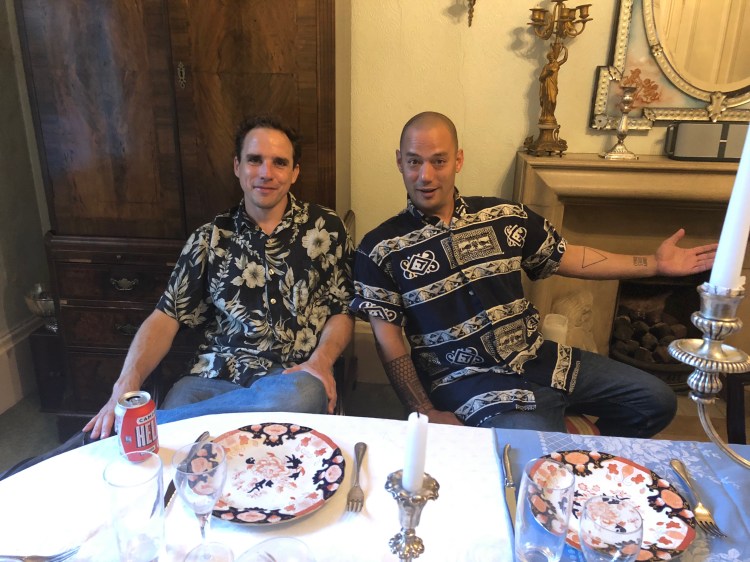
One final coincidence for the Rosh Hashanah dinner. Two of my favourite people were there that evening- Guy (my amazing brother) and Lee (my friend and owner of the excellent Bong Bongs Filipino restaurant at Seven Dials Market). They have met only once for a few minutes, they live on opposite sides of London, and I have never seen either of them wearing these shirts before. But here they are. I thought this was worthy of my first and possibly only inclusion of people photos on this blog.
Shanah Tovah!


