I know a yeast story.
How often do people start conversations that way? I would have said never, but it’s been a year of lockdowness and home-baking, so there’s a chance that somewhere, somehow, someone has said that sentence before me (it was probably ten a penny in the 1940s).
Speaking of the 1940s, here is the story.
In 1942, Adnams Brewery in Southwold, Suffolk, was in dire straits- the yeast was infected. As any keen sourdoughers know, this inevitably put a halt on all things hoppy. Adnams trotted down the road, beaker in hand, to Morgans Brewery of Norwich and bought a batch. Not long after, the whole Morgans brewery was destroyed in an air raid. The 1942 yeast is still in use by Adnams. The idea that there is an 80 year old yeast alive and well today is strangely moving (and unsurprising to anyone who arranges for people to feed their yeast when they go on holiday). The story is also a reminder of all the windows into history we walk past and forget to look in. If I hadn’t heard the yeast tale I’d never have learnt about the WW2 Baedeker air raids on historic cities- York, Canterbury and Norwich, where buildings of cultural importance were targeted. The name came from Baedeker, a series of German tourist guidebooks which included detailed maps that were used to generate the targets. And I would never have known the story of John David Grix, a 15 year old cycle messenger who during the Norwich raids put out an incendiary bomb and saved a house by closing off a gas leak. He became the youngest person to receive a gallantry award.
Thank you yeast.
And thank you to my friend popular science author Lewis, who took time out from writing his follow-up to the best-selling Origins, to help me with the bread. I was going to say it was apt that someone who describes the impact of geology on human evolution should be with me for my first attempt at the bedrock of Ashkenazi food, but the truth is I needed him (how did I resist saying ‘kneaded’ there?). He is the yeast whisperer.
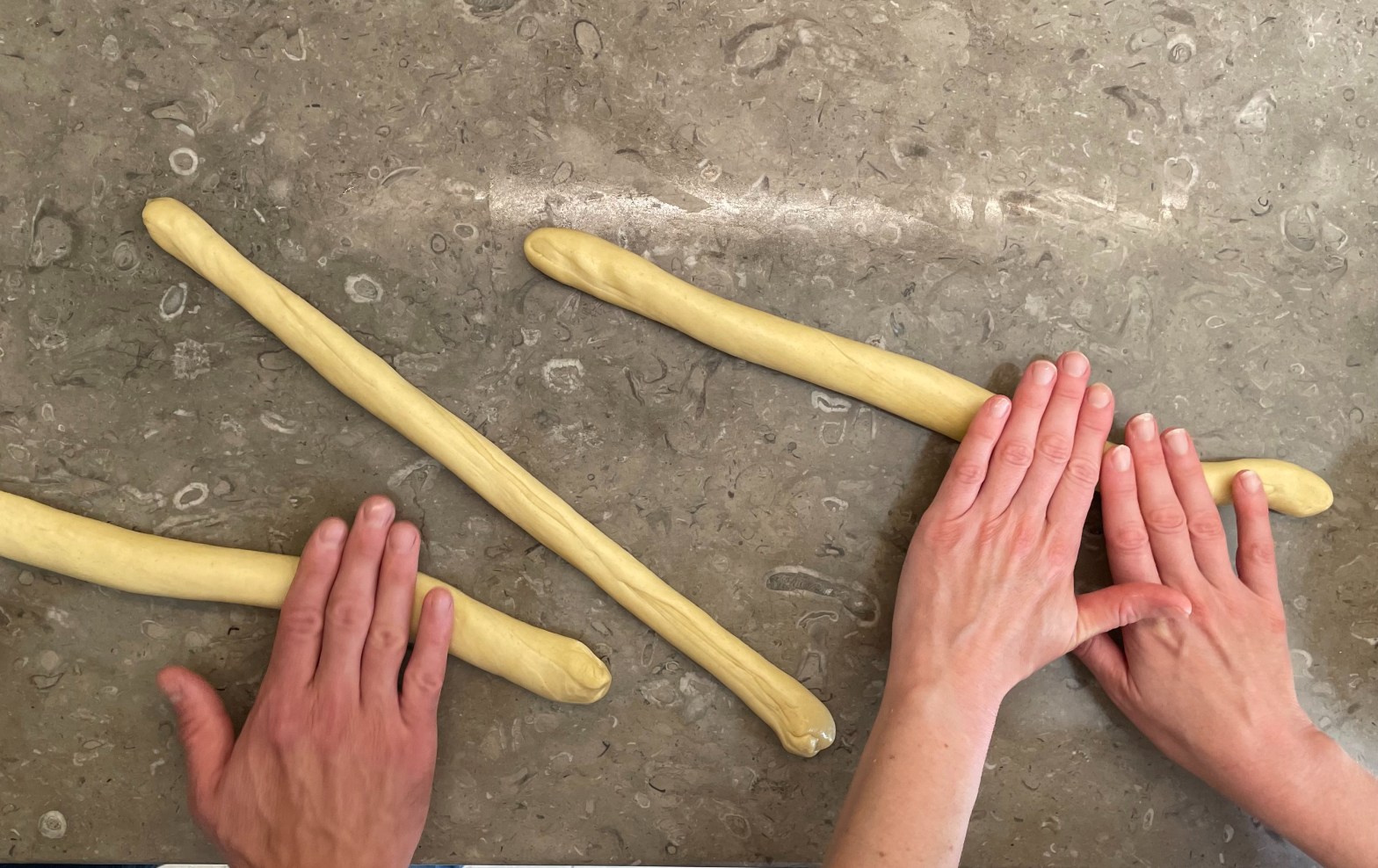
Prepare your yeast (2 tablespoons dry yeast, 1 teaspoon sugar and 500ml lukewarm water). Beat 4 eggs, add 1 tablespoon salt, 100g sugar, 125ml oil and beat again, add the now frothy yeast mixture. Add 1.3k plain flour slowly, to make a soft dough. Knead it until it is elastic and put it in a greased bowl. Set aside for 2-3 hours or until doubled in bulk. When it has doubled, punch the dough down and knead it again, then divide into four pieces. Each piece you divide to create three rolls (see the picture) which you then braid together. Once you’ve finished your plaiting, pop the loaves on a baking tray and leave them to rise for an hour. Brush with beaten egg yolks then put them in the oven for 30-4o minutes or until golden brown.
The three strands of the hallah represent truth, peace and justice. In the interests of ensuring the first, I have to disclose that the hallah didn’t work. The eagle-eyed amongst you might have noticed from the picture that our dough strands were too long, perhaps this was the problem, perhaps it was because we didn’t allow the stipulated rising time. Perhaps, perhaps, perhaps.
I’ve decided the best way to approach my hallah-failure is to look at the symmetry, not so much with the loaf, which was deeply unsymmetrical, but with the time of baking. We made the bread two days after I’d been to the mikveh (ritual immersion) to complete the conversion process. Just as I was starting out on a journey into my Jewish life, I took the first step towards hallah-greatness. The fact that that step was a firm and solid one, seems only appropriate.

 Nom Nom Yom