I spent my Saturday night cleaning. At 10pm it was just me, a mop and a bucket. When I took a break and leaned on the mop, resisting the temptation to wheel around with it like a smooth gliding dance partner, I realised I’d gone full Cinderella, dreaming of a fairy godmother who’d magic me away to the ball, and wearing an old snood as a headscarf. When he first saw it a while ago (these have been hairdresser-less months) Hesham said “nice tichel.” I nodded and slyly googled “tichel.” Before I quickly move on to slow cooked rice, I’d like to reflect the loveliness of a Muslim friend teaching me Yiddish.
In the spirit of my La Cenerentola moment I’m leaning in, not just to my mop, but to the delights of Italian Jewish cooking.
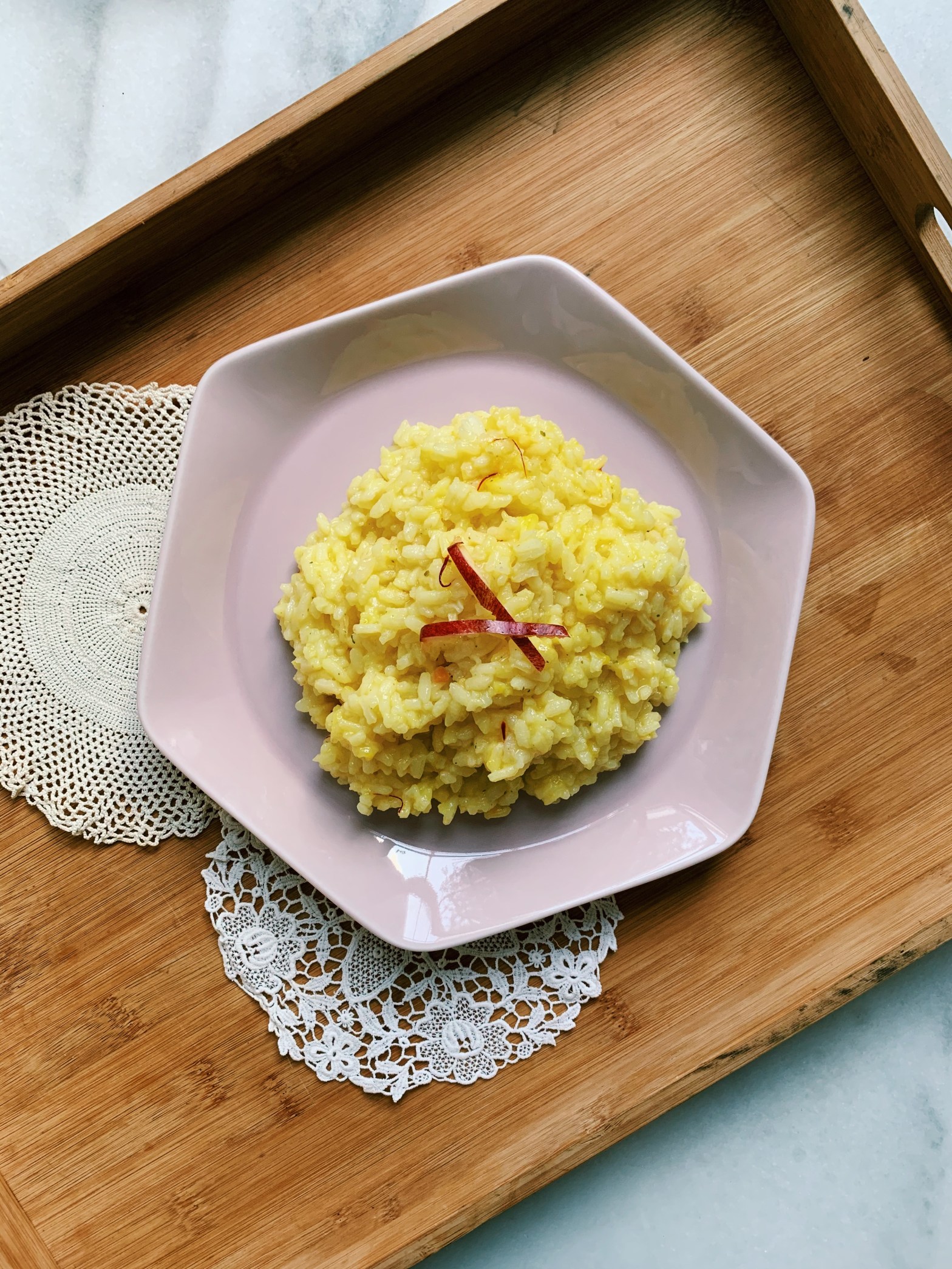
Risotto Giallo (full name Risotto Giallo del Shabbat) is, Claudia Roden explains, said to be the origin of the famous Risotto alla Milanese. It’s an old Jewish speciality of Ferrara and Venice and served on the Sabbath as a first course or a side dish. I’m going to come on later to how delicious it is, but I’ll preface this by saying that it was so delicious I ate it as a first course, then as a side dish, then just gave up self-denial and ate it as a main course, all in the course of one evening.
I am not going to dwell on how simple it is, because Emma says that in this blog I sell my culinary skills short. Instead I’ll say that cooking the rice (about 300g) in oil until it is “translucent,” is much harder than it sounds (hint: it isn’t). Adding a litre of stock, pouring it onto the rice, stirring it once, and putting the lid on the pot, is the very definition of taxing. You leave the lid on for about 20 mins until the rice has soaked up all the liquid but hasn’t gone into the irretrievably mushy stage. Your anxiety levels will be peaking at this point (correction: they won’t, not unless you’re watching Eurovision at the same time). Five minutes before the end you stir in a few strands of the saffron so it steams with the rice and turns it a wonderful, well, yellow. Roberto’s your uncle!
Even for those who, like me, know little about the 500 years of Jewish history in Venice, there are two associations that likely come to mind- Shakespeare’s play and the word “ghetto.” The origin of the second (and come to think of it the first) are disputed. The most commonly accepted etymology is that it comes from the Venetian word “ghèto” meaning “foundry” as there was one near the site of the Jewish area of the city. Other theories are that it comes from the Hebrew “get” meaning bill of divorce or the Yiddish “gehektes”, meaning “enclosed.” Whatever it’s derivation, it remains a word which, as Daniel B Schwartz (who has written a book on the history of it) says, “carries a special ideological charge and is capable of evoking images and associations that exceed any dictionary definition of the term.”
The still-named Ghetto Nuovo in Venice has a particular resonance for me. It’s where I went into a synagogue for the first time-the Scuola Grande Tedesca, built in 1528 by the Ashkenazi community and the oldest of the five synagogues in Venice (all of them termed “scuola” rather than “sinagoga,” just as the Ashkenazim would use the Yiddish “shul.”).
Back then, I could never have imagined I’d be writing this blog, making Claudia’s fiendishly difficult yellow rice and attending my own shul, but “non tutte la ciambelle riescono col buco.” In this case, it’s a very good thing.

 Nom Nom Yom