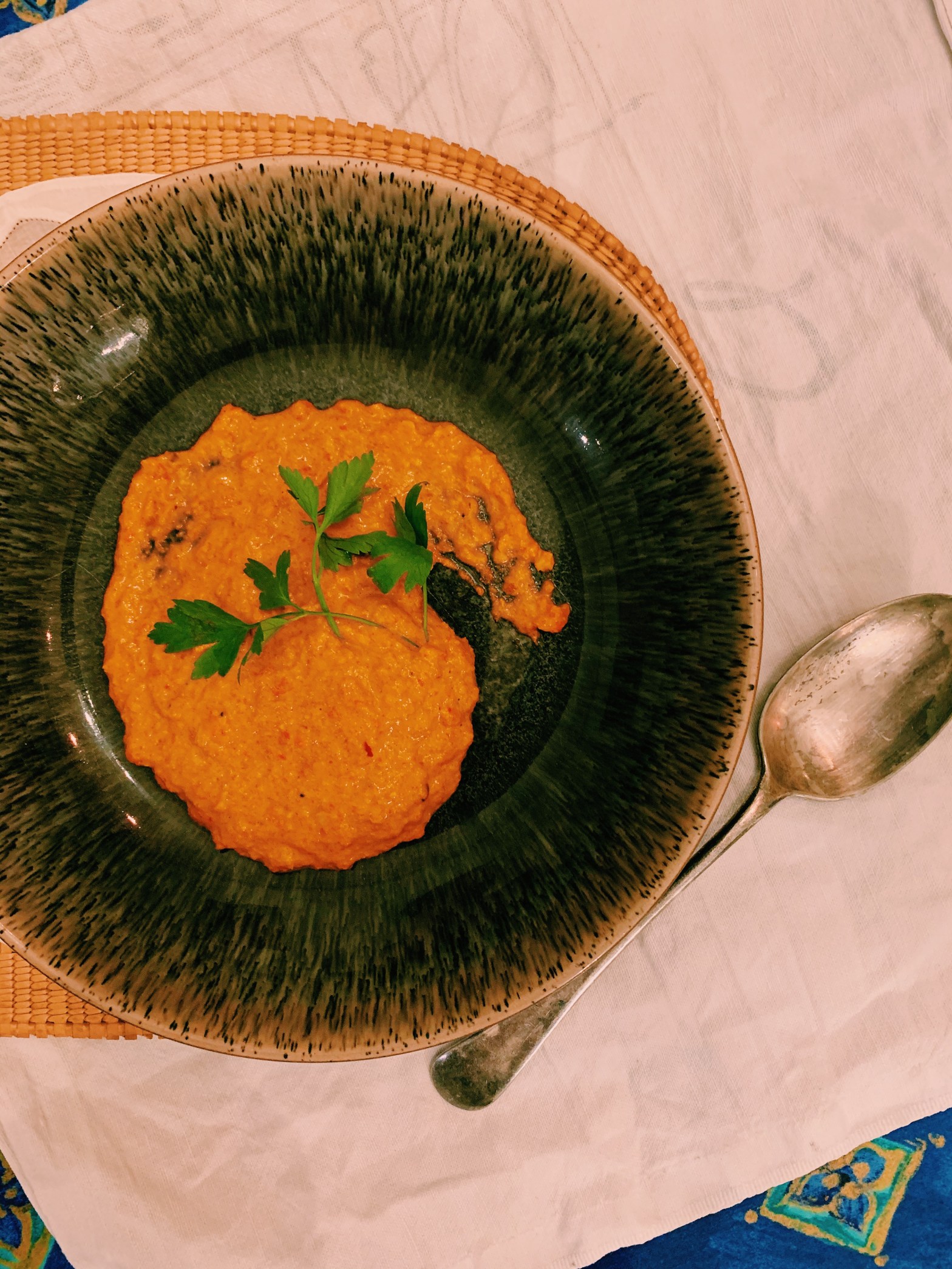
If you’ve never said the word ‘muhammara,’ out loud I’d recommend it. Say it a few more times, it just sounds lovely and if you were a fan of Thundercats growing up, it may also remind you of one of the characters.
Muhammara means ‘reddened’ in Arabic, which makes sense because it’s made with roasted red peppers. Roasted in the sense that you start out by putting them as they are, no oil, no salt, no nothing, under the grill, turning them until all the skin is blackened (keeping an eye on them, I say this for myself more than anyone else- how in the spirit of a blog- I have a story about setting fire to a mince pie in a client’s offices, almost causing a major incident). You leave them to cool, then peel off the skin with your fingers, and pull out the stalk. I have heard that if you put them in a brown paper bag straight out of the oven, it will steam off the skin so you don’t even need to pick at it. Mine worked well enough without the bag (but I’ll keep one handy for later when I’m hyperventilating about the carp- see my post Join me on my Journey). Most of the seeds will come with the stalk, and you’re left with juicy red peppers and a delicious slightly charred smell. A surprising amount of the peppers’ natural oils come out and would make a great easy dressing if you just sliced the peppers and put them on spinach leaves with feta.
I chose Muhammara as my first dish because half of my household is vegan, so the recipe didn’t require any adaptation (going forward if I’m going to feed anyone other than myself I’ll have to work out what to do about all the eggs and cheese in Jewish cooking, I can see myself buying a lot of chickpeas for their water and potato starch). I also chose it because it’s hard to mess up something that turns into a ‘thick paste’ once you’ve whizzed up all the ingredients.
I also think it’s an interesting reminder of a word I’ve just learnt- “Ashkenormative.” I’m applying this now (out of context) to remark on the perception of Jewish food, certainly where I grew up, as very much based on Askhenazi cuisine (chicken soup, latkes, gefilte fish), rather than the Sephardi and other influences. Finally, wrapped up in this, it’s a nod to a controversy, which I am not going to weigh in on, over whether Jews can lay claim to particular foods: http://www.bbc.com/travel/story/20171211-who-invented-hummus
Claudia’s recipe is a Syrian one from Dalia Carmel, and although hers does not specifically call for it, other recipes say the key ingredient is Aleppo peppers (another wonderful thing to say out loud). Yotam Ottolenghi also has a recipe.
It’s essentially walnuts, peppers, a bit of bread (Claudia uses two slices of brown bread with the crusts cut off, not the breadcrumbs which Ottolenghi’s recipe calls for), pomegranate molasses, lemon, a whole chilli, oil and seasoning blended together. Ottolenghi says he can’t live without garlic, I’ve had to for a long time, as consecutive boyfriends were allergic/intolerant (to garlic, and me, as it turns out), and one of my household now is too. I followed Claudia’s recommendation of adding in cumin to make sure it had some punch.
The bagels had what can best be described as a charitable reception at dinner last night (on which more later). But the Muhammara went down very well. I found myself saying, “is it wrong to love my muhammara?”

 Nom Nom Yom